Jun 13, 2012

The Holy Eucharist: Central Sacrament Pre-figured in the First Passover

The Holy Eucharist: Central Sacrament Pre-figured in the First Passover


The Holy Eucharist: Central Sacrament Pre-figured in the First Passover


June 9, 2012 - Jayson M. Brunelle, CAGS


The Eucharist  is the single, greatest gift Christ left to his Church, fulfilling his promise to be with us always.
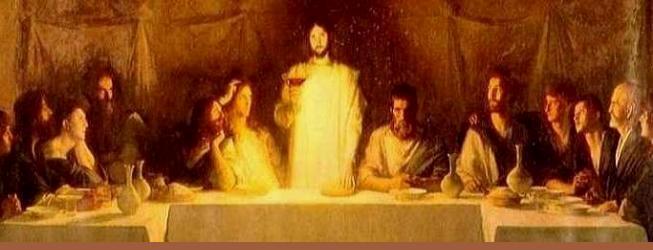


The Last Supper
Christ’s institution of the sacrament of the Eucharist was, and is, the single, greatest gift he left to his Church.  For, it is the fulfillment of his promise to truly be always among us: “And know that I am with you always; yes, to the end of time” (Mt 28:20).  While there are, indeed, multiple and varied presences of Christ, such as: when two or three are gathered in his name; when the People of God gather to celebrate the Liturgy; when Sacred Scripture—the Word—is proclaimed; or when the priest acts in Persona Christi while administering and officiating at any of the Sacraments, etc. The abiding Eucharistic presence of Christ, with the fullness of his Body, Blood, Soul and Divinity is truly singular in its reality, intensity, substance and fullness.
While the accidents of bread and wine remain, the substance is completely transformed into the Second Person of the Trinity. Holy Mother Church refers to this supernatural process—whereby our gifts of bread and wine are wholly transformed into the true presence of Christ—as Transubstantiation.  Thus, while the appearance of bread and wine remain, the substance has been wholly and completely transformed into the very substance of the Second Person of the Holy Trinity. This occurs during the Liturgy of the Eucharist, specifically during the priest’s prayer of consecration, and immediately following the Epiclesis. Regarding the wholly unique presence of Christ, contained within the pre-eminent sacrament of the Holy Eucharist, the Catechism of the Catholic Church has this to say: “The mode of Christ’s presence under the Eucharistic species is unique. It raises the Eucharist above all the sacraments as ‘the perfection of the spiritual life, and the end to which all sacraments tend.’ In the most blessed sacrament of the Eucharist, ‘the body and blood, together with the soul and divinity, of our Lord Jesus Christ and, therefore, the whole Christ, is truly, really, and substantiallycontained.’  This presence is called ‘real’—by which is not intended to exclude the other types of presence, as if they could not be ‘real’ too, but because it is presence in the fullest sense: that is to say, it is a substantial presence by which Christ, God and man, makes himself wholly and entirely present” (CCC §1374).
Lumen Gentium, the Second Vatican Council’s “Dogmatic Constitution on the Church,” refers to the Eucharist as the source from which all the Church’s activity originates, and the summit toward which all the Church’s activity is directed. Based on this essential teaching of the Council, which reiterated 2000 years of Church teaching on the Eucharist, we can come to understand that the Eucharist truly is the “central Sacrament” in the sense that the Eucharist is “the end to which all sacraments tend.” This truth fleshes out the reality that each of the other Sacraments, while possessing a specific purpose in their own right, ultimately serve the greater purpose of leading souls to full participation in the Eucharistic banquet. This is nothing short of a foretaste of the heavenly banquet, where we will participate in God’s own divine life. For example, while the sacrament of Baptism has the specific purpose of forgiving original sin, and imparting sanctifying grace, its greater purpose is to allow the baptized to fully partake of the Eucharistic banquet. For, unless one is Baptized, he or she cannot fully participate in the Liturgy of the Eucharist, and be nourished with Christ’s body and blood. Moreover, it is essential that we be nourished with this “bread from heaven,” because, as Christ himself states: “I tell you most solemnly, if you do not eat the flesh of the Son of Man, and drink his blood, you will not have life in you” (Jn 6:53).  Just as it is with Baptism, so is it with all the remaining sacraments. Reconciliation makes it possible for us to return to the Eucharist after we have fallen. Confirmation imparts the seven-fold gifts of the Spirit to better prepare us to enter into the mystery of the Eucharistic Pasch. Matrimony pre-figures the great wedding-feast of the Lamb, referred to in the book of Revelation, with Christ as the Bridegroom, and his Mystical Body, the Church, as his Bride. Clearly, the sacrament of Holy Orders is primarily concerned with imparting sacramental “character” on the priest’s soul, thereby enabling him to act in Persona Christi, chiefly for the sake of celebrating the Holy Sacrifice of the Mass. This is where, of course, the Eucharist is made present, and with which the Baptized are spiritually nourished. Finally, there is the Anointing of the Sick, of which reception of the Eucharist, or viaticum (bread for the journey), is an integral part. Thus, it is quite clear that each of the Sacraments has, as its ultimate end, the facilitation of participation in the Eucharistic banquet.
As an aside, it most curious that many Protestant groups, especially fundamentalists—who tend to interpret almost all of Scripture in a most literal fashion—stop short of a literal interpretation of Christ’s teachings on the Eucharist, which they strangely regard as merely symbolic.  Let us turn to Scripture itself to read with our own eyes just what Christ stated regarding the Eucharist. Beginning in Jn 6:48, and continuing in John, Jesus states:  “I am the bread of life.  Your fathers ate the manna in the wilderness, and they died. This is the bread which comes down from heaven, that a man may eat of it and not die.  I am the living bread which came down from heaven; if anyone eats of this bread, he will live forever; and the bread which I shall give is my flesh for the life of the world…. Truly, truly, I say to you, unless you eat the flesh of the Son of man, and drink his blood, you have no life in you; he who eats my flesh and drinks my blood has eternal life, and I will raise him up on the last day.  For my flesh is food, indeed, and my blood is drink, indeed.  He who eats my flesh and drinks my blood abides in me, and I in him.” And then again, in Mt 26:26, the following is narrated:  “Now on the night he was betrayed, the Lord Jesus took some bread, and when he had said the blessing, he broke it.  And he gave it to the disciples, saying: ‘Take it and eat.  This is my body.’  Then he took a cup, and when he had given thanks, he gave it to them.  ‘Drink all of you from this,’ he said.  ‘For this is my blood, the blood of the new covenant, which is to be poured out for many for the forgiveness of sins.’”  If fundamentalist Protestant Christians tend to interpret almost everything in Scripture literally, then why not these words of Christ?
Having addressed the above curious issue, let us now discuss the marvelous effects of a well-received Holy Communion. The Catechism of the Catholic Church states that “The principle fruit of receiving the Eucharist in Holy Communion is an intimate union with Christ Jesus.” Moreover, the Catechism continues, Holy Communion “preserves, increases and renews the life of grace received at Baptism” (CCC §1391). Thus, this Living Bread, come down from Heaven, truly nourishes the divine life in our souls.  Just as the body needs material food to be nourished, strengthened and rejuvenated, so, too, does our soul need the spiritual food of the Eucharist to nourish, strengthen, enliven and rejuvenate the divine life that is the soul of our soul.
Secondly, “the Eucharist cannot unite us to Christ without, at the same time, cleansing us from past sins, and preserving us from future sins” (CCC §1393).  Reception of this sacrament increases our charity, and forgives us our venial sins.  Simultaneously, in strengthening our charity, it facilitates our bond with Christ, making it that much more difficult to extinguish the divine life within us, through commission of mortal sin.  Although Holy Communion does, in fact, forgive us our venial sins, we are not permitted to receive this sacrament if we have fallen into mortal sin, as the Eucharist is the sacrament of the living, or those in full communion with the Mystical Body, the Church.  Forgiveness of mortal sins properly takes place within the context of the sacrament of Reconciliation.
What is more, the Eucharist builds up the Church, the Mystical Body of Christ, by uniting us through the bond of charity with Christ, the Head of the Body, and with the members of his Body.  The Eucharist is the fulfillment of the Baptismal grace, which unites and conjoins us to the Church:  “Because there is one bread, we who are many are one body, for we all partake of the one bread” (1 Cor 10:16-17).
The Eucharist is also “A pledge of future glory.” A beautiful ejaculatory prayer, composed by the great St. Thomas Aquinas, and soon adopted by the Church, provides a catechetical summary of the Eucharist. It reads as follows:  “O Sacred Banquet, in which Christ is received, the memory of his passion is renewed, the soul is filled with grace, and a pledge of future glory is given to us.”  It would behoove us to commit this prayerful ejaculation to memory, as it wonderfully, and simply, sums up the most salient catechetical tenets concerning the Eucharistic doctrine.  We are, however, chiefly concerned here with the final thought contained in this prayer.  For, Christ pledges to “raise up on the last day” those who “eat the flesh of the Son of man, and drink his blood.”  The Sacred Liturgy is an earthly foretaste of the heavenly Banquet, the wedding feast of the Lamb, spoken of in the book of Revelation.  Thus, the coming of Christ in the Eucharist takes on an eschatological significance, as each Eucharistic celebration pre-figures the second coming of Christ—that eschatological reality for which the human heart ardently longs, as we pray with the Church:Maranatha! Come, Lord Jesus!
Finally, because Jesus is truly present, in an abiding fashion, with his body, blood, soul and divinity in the Eucharistic species of bread and wine, it is laudable to practice devotion to his Eucharistic presence in the consecrated and reserved host.  A consecrated host should be placed in a monstrance, which should then be placed on the altar, preferably surrounded by candles and flowers, in order that the faithful might practice the pious devotion of Eucharistic Adoration.  While it is theologically correct to say that the Eucharist is primarily meant to be consumed by Catholic Christians in a state of grace, solemn veneration of the Eucharist exposed is a most salutary and pious practice, encouraged by popes, saints and doctors of the Church.  Eucharistic adoration can be seen as a response to Christ’s call to his disciples to “keep watch with [him] for one hour” (Mt 26:40)—hence, the origins of the practice of the Eucharistic Holy Hour.
The Passover:  Christ as the Lamb of Sacrifice and the Pre-figuring of the Paschal Mystery
At the last supper, the single most important Passover meal ever celebrated, Christ manifested his identity as the Passover lamb of sacrifice.  In the Old Testament, during the very first Passover, the Israelites prepared a sacrificial meal in haste, as they prepared to be set free from their slavery in Egypt. On this occasion, an innocent, unblemished lamb was sacrificed.  The blood of the sacrificed lamb was placed on the doorposts of the Israelites houses, to save the firstborn males from death.  The lamb, which was slain as a sacrifice to the Father, was then consumed by the Israelites to strengthen them for their journey through the desert, toward the Promised Land. Moreover, as the Jews wandered throughout the desert, they were fed with manna, a bread from heaven, which was divinely given to them by God on a daily basis.  In the New Testament, Jesus is the unblemished Lamb of God, who offers himself as a sacrifice of atonement to the Father, thereby saving us from the death of sin and hell, setting us free from our slavery to sin.  It is precisely his blood that saves us from spiritual death.  Moreover, Jesus offers us his own body, which has just been sacrificed, to spiritually strengthen us on our journey through the desert of this life, as we make our way to the Promised Land of Heaven.  Moreover, Jesus is the manna, the “bread from heaven,” that we are nourished with, on a day-to-day basis, according to the providence of the Father, and his unfailing solicitude for the spiritual, and material, well-being of each of his children.
Thus, to truly enter into the mystery of the Eucharistic Pasch, we need to turn our attention to the Old Testament narrative of the very first Passover meal.  Only then, will we begin to understand, however superficially (after all, this is a mystery of the deposit of faith):  the tremendous significance of our Eucharistic Passover meal—the sacrifice in the Holy Sacrifice of the Mass; and the grand mystery of Christ’s infinite, perfect, merciful and, sadly, often unrequited, love for humanity—in his real presence in the Eucharist.
About Jayson M. Brunelle, M.Ed., C.A.G.S
Jayson M. Brunelle, M.Ed., C.A.G.S., holds a B.A. in philosophy and theology from Franciscan University of Steubenville, Ohio; an M.A. in education in counseling psychology, a certificate of advanced graduate studies in clinical mental health counseling from Springfield College, Springfield, Massachusetts; and a certificate of completion from the pre-theology program at St. John’s Seminary, Brighton, Massachusetts. Brunelle has been published in the Homiletic and Pastoral Review and Lay Witness, and presented papers at the 8th International Congress on Constructivism and Psychotherapy in Bari, Italy. He is the author of the books: The Blessed Mother’s Plan to Save Humanity, Consecration to Jesus Christ through Mary and Joseph, and The Five Ways of Aquinas. He has guest-lectured at Springfield College, Western New England College, and Holyoke Community College, and worked as a chaplain at Suffolk County Prison.

Jun 8, 2012

Et Incarnatus Est

I think it's about time I explain why the blog has its title.  It comes from the Latin original of the Credo (the one where we say "incarnate of the Virgin Mary", thanks to the new translation that debuted during Advent), which literally is, "et incarnatus est".  He was incarnate of the Virgin Mary.

The incarnation of Christ is extremely unique, very powerful, and astonishing.  What do you mean, he took on our skin and bones (that's what incarnate means) and dwelt among us?  This is at the heart of everything Christians believe.  We believe that God became man. This has extraordinary impact on all our lives, especially given our doctrine of baptism, where we outwardly look like we're just getting sprinkled with some water, but we are actually being initiated into the family of God.  That's pretty intense, no?  Literally, that's our adoption ceremony - we are literally cleansed and receive the Holy Spirit. We become heirs to God!!  This also means we take part in the life and love of the Trinity.

What else does this mean, though?  We are sons of God through this adoption, which is pretty incredible.  That means we are Christ to the world.  The incarnation of Christ happens again and again throughout history, especially through his followers.  What we do has a huge impact because of this!  We are ambassadors of Christ - what we do as Christians, the world follows as though we were Christ ourselves. We must be very careful to live as good examples.

There are other implications to the incarnation of Christ, though.  We are a people of Christmas and Easter.  Christ took on flesh, and sacrificed it.  That's why He did it.  He did it to pour Himself out for all of us.  We believe in this bodily reality of Christ, which is the source, summit, and summary of all our Christian lives.  Even marginal Christians understand that if you go to Church at all, you do it on Christmas and Easter, where we celebrate the body and corporal reality of Christ. The bodily reality of Christ is the singular most important belief we hold not only as Christians, but Catholics.  All the sacraments are about embodying Christ, giving Christ a body, being a tabernacle, being a physical, present symbol for the realities of God.  We are asked to be like Mary and carry Him about and bring Him forth as a gift in the world. We don't have control over what the world does with the incarnation of Christ; we are asked to bring Him forth anyway.

Now, in light of the coming feast of Corpus Christi (the body of Christ), we should remember that the bodily presence of Christ permeates all parts of our lives as Christians (because it is easy to forget - why do you think God tells the Israelites so many times to "remember"?).  We have the Eucharist!  I posted the homily Pope Benedict gave - the Eucharist is the ultimate proof that Christ has never abandoned us.  He is always physically present in the Eucharist.  St. Peter Emyard said that Christ takes on the form of a dead corpse in the bread, but His Heart is ever blazing with love and fully alive. He trusts us to take Him into the world and live out the incarnation every day.

Christians, in sum, have reason to celebrate.  Christ dwelt among us, as a incredibly present, corporeal person, and still dwells with us today!

EWTN.com - That Bread Is Really Jesus Christ

EWTN.com - That Bread Is Really Jesus Christ

7-June-2012 -- ZENIT.org News Agency


That Bread Is Really Jesus Christ

Rome's Director of Liturgy Explains Importance and Meaning of Corpus Christi Feast

By Salvatore Cernuzio

ROME, JUNE 5, 2012 (Zenit.org).- This Thursday, Benedict XVI will preside over Holy Mass in the courtyard of Saint John Lateran, and then lead the procession of the Body of Christ to the Basilica of Saint Mary Major.

To prepare for this feast of Corpus Christi, ZENIT interviewed Carmelite Father Giuseppe Midili, director of the Liturgical Office of the Vicariate of Rome.

ZENIT: Corpus Christi celebrates the Eucharist, fulcrum of the Christian faith. What is the meaning of this solemnity?

Father Midili: Eucharist means thanksgiving. Every day, especially on Sunday, the Church gathers to celebrate the holy mysteries and to thank the Father for the gift of his Son, who offered his life in sacrifice for us and merited salvation for us. The Solemnity of the Body and Blood of the Lord is the liturgical occasion for a special thanksgiving. The Christian community gathers to become conscious that only in the Eucharist does it find the summit and source of its whole life. Every act of faith, every form of piety, of devotion, every form of genuine charity can never do without this sacrament.

ZENIT: The birth of this feast goes back to what date?

Father Midili: The Solemnity of the Body and Blood of the Lord was instituted in 1264 by Pope Urban IV, so that the Christian people could participate with special devotion in the Holy Mass and in the procession, and thus witness their faith in Jesus, who willed to remain present under the species of consecrated bread and wine. In the course of the centuries this solemnity constituted the highest point of Eucharistic devotion, because it united devoted adoration to that original event, which we cannot do without, which is the celebration of the Mass.

ZENIT: The celebration of Corpus Christi at Saint John Lateran was started by John Paul II. Why did he wish to give it such great importance?

Father Midili: Since the year 1979 Pope John Paul II wanted the Solemnity of the Body and Blood of the Lord to be celebrated in Rome on Thursday, because in fact on Holy Thursday Jesus gathered his disciples and during the Supper instituted the new and eternal sacrifice, the nuptial banquet of love. On the feast of Corpus Christi this same mystery is proposed for the adoration and meditation of the People of God.

The Pope wished to celebrate in the Cathedral of Rome, together with all the priests and faithful of the city, because the Eucharist is the mystery of communion with God, but also among persons. The best image of the Church, in fact, is that which is constituted around the Bishop to celebrate the divine mysteries, to eat and drink the Body and Blood of the Lord, to give thanks and thus witness the communion and love that Jesus taught.

ZENIT: Why is this feast in the courtyard of the Basilica of Saint John?

Father Midili: Saint John's Square is at the same time the courtyard of the Basilica Cathedral of Rome, but it is also the place of public gatherings for the city and for Italy; it is often the scene of concerts, of political events and, unfortunately, also of clashes; it is the Agora of the ancients. It became a symbol of our country, it is a courtyard-square.

To celebrate Holy Mass in such a significant place on the day of the feast of the Eucharist confirms that Jesus is in the midst of his people at every moment of life. He sanctifies the everyday with his presence, sees and heals suffering, he is for all a sign of hope. Jesus is not far from us and from our life, but is always present, he made himself close. We can meet him in the celebrated Eucharist and in the consecrated bread. He comes to meet us.

ZENIT: The procession, led by the Holy Father is an event of great impact whose central idea is that "Christ walks in our midst."

Father Midili: The Holy Mass and procession on the Solemnity of the Body and Blood of the Lord is a unique event, which manifests the Church as Church. It is the feast of the gathered community. Believers come together to celebrate the sacrifice of Christ and, in the celebration, they thank God for all that they have received. The best image of the Church is the one gathered around her bishop to celebrate the holy mysteries, to eat and drink the Body and Blood of the Lord, to give thanks and thus witness the communion and love that Jesus has taught us.

Adoration is the continuation of the celebrated Eucharist, testimony of love and faith toward Jesus, prolongation of the thanksgiving after every Holy Communion. Once again the Church identifies herself with the journeying people, who follow their Master. The experience of the disciples of Emmaus is repeated, who travel a way with Jesus and listen to him while he instructs them. In the Eucharistic procession the community journeys with Jesus, but does not recognize him more while he breaks the bread. We recognize the Master present in that bread.

[Translation by ZENIT]

EWTN.com - Pope's Corpus Christi Homily

EWTN.com - Pope's Corpus Christi Homily


8-June-2012 -- ZENIT.org News Agency


Pope's Corpus Christi Homily


ROME, JUNE 7, 2012 (Zenit.org).- This evening in Rome, Benedict XVI celebrated Mass for the feast of Corpus Christi at the Basilica of St. John Lateran. He then led the traditional procession to the Basilica of Saint Mary Major.

Here is a translation of the Pope's homily.

* * *

Dear Brothers and Sisters!

This evening I would like to meditate with you on two interconnected aspects of the Eucharistic Mystery: the worship of the Eucharist and its sacredness. It is important to take it up again to preserve it from incomplete visions of the Mystery itself, such as those which were proposed in the recent past.

First of all, a reflection on the value of Eucharistic worship, in particular adoration of the Most Blessed Sacrament. It is the experience that we will also live after the Mass, before the procession, during its development and at its end. A unilateral interpretation of Vatican Council II has penalized this dimension, restricting the Eucharist in practice to the celebratory moment. In fact, it was very important to recognize the centrality of the celebration, in which the Lord convokes his people, gathers them around the twofold table of the Word and the Bread of life, nourishes them and unites them to Himself in the offering of the Sacrifice. This assessment of the liturgical assembly, in which the Lord works and realizes his mystery of communion, remains of course valid, but it must be placed in the right balance. In fact - as often happens - the stressing of one aspect ends up by sacrificing another. In this case, the accentuation placed on the celebration of the Eucharist has been to the detriment of adoration, as act of faith and prayer addressed to the Lord Jesus, really present in the Sacrament of the altar. This imbalance has also had repercussions on the spiritual life of the faithful. In fact, concentrating the whole relationship with the Eucharistic Jesus only at the moment of Holy Mass risks removing his presence from the rest of time and the existential space. And thus, perceived less is the sense of the constant presence of Jesus in our midst and with us, a concrete, close presence among our homes, as "beating Heart" of the city, of the country, of the territory with its various expressions and activities. The Sacrament of the Charity of Christ must permeate the whole of daily life.

In reality, it is a mistake to oppose celebration and adoration, as if they were in competition with one another. It is precisely the contrary: the worship of the Most Blessed Sacrament is as the spiritual "environment" in which the community can celebrate the Eucharist well and in truth. Only if it is preceded, accompanied and followed by this interior attitude of faith and adoration, can the liturgical action express its full meaning and value. The encounter with Jesus in the Holy Mass is truly and fully acted when the community is able to recognize that, in the Sacrament, He dwells in his house, waits for us, invites us to his table, then, after the assembly is dismissed, stays with us, with his discreet and silent presence, and accompanies us with his intercession, continuing to gather our spiritual sacrifices and offering them to the Father.

In this connection, I am pleased to stress the experience we will also live together this evening. At the moment of adoration, we are all on the same plane, kneeling before the Sacrament of Love. The common and ministerial priesthoods are united in Eucharistic worship. It is a very beautiful and significant experience, which we have experienced several times in Saint Peter's Basilica, and also in the unforgettable vigils with young people - I recall, for example, those of Cologne, London, Zagreb, Madrid. It is evident to all that these moments of Eucharistic vigil prepare the celebration of the Holy Mass, prepare hearts for the encounter, so that it is more fruitful. To be all together in prolonged silence before the Lord present in his Sacrament, is one of the most genuine experiences of our being Church, which is accompanied in a complementary way with the celebration of the Eucharist, listening to the Word of God, singing, approaching together the table of the Bread of life. Communion and contemplation cannot be separated, they go together. To really communicate with another person I must know him, I must be able to be in silence close to him, to hear him and to look at him with love. True love and true friendship always live of the reciprocity of looks, of intense, eloquent silences full of respect and veneration, so that the encounter is lived profoundly, in a personal not a superficial way. And, unfortunately, if this dimension is lacking, even sacramental communion itself can become, on our part, a superficial gesture. Instead, in true communion, prepared by the colloquy of prayer and of life, we can say to the Lord words of confidence as those that resounded a short while ago in the Responsorial Psalm: "O Lord, I am thy servant; I am thy servant, the son of thy handmaid. / Thou hast loosed my bonds./ I will offer to thee the sacrifice of thanksgiving /and call on the name of the Lord" (Psalm 115:16-17).

Now I would like to pass briefly to the second aspect: the sacredness of the Eucharist. Also here we heard in the recent past of a certain misunderstanding of the authentic message of Sacred Scripture. The Christian novelty in regard to worship was influenced by a certain secularist mentality of the 60s and 70s of the past century. It is true, and it remains always valid, that the center of worship is now no longer in the rites and ancient sacrifices, but in Christ himself, in his person, in his life, in his paschal mystery. And yet, from this fundamental novelty it must not be concluded that the sacred no longer exists, but that it has found its fulfillment in Jesus Christ, incarnate divine Love. The Letter to the Hebrews, which we heard this evening in the Second Reading, speaks to us precisely of the novelty of the priesthood of Christ, "high priest of the good things that have come" (Hebrews 9:11), but it does not say that the priesthood is finished. Christ "is the mediator of a new covenant" (Hebrews 9:15), established in his blood, which purifies our "conscience from dead works" (Hebrews 9:14). He did not abolish the sacred, but brought it to fulfillment, inaugurating a new worship, which is, yes, fully spiritual but which however, so long as we are journeying in time, makes use again of signs and rites, of which there will be no need only at the end, in the heavenly Jerusalem, where there will no longer be a temple (cf. Revelation 21:22). Thanks to Christ, the sacred is more true, more intense and, as happens with the Commandments, also more exacting! Ritual observance is not enough, but what is required is the purification of the heart and the involvement of life.

I am also pleased to stress that the sacred has an educational function, and its disappearance inevitably impoverishes the culture, in particular, the formation of the new generations. If, for example, in the name of a secularized faith, no longer in need of sacred signs, this citizens' processions of the Corpus Domini were abolished, the spiritual profile of Rome would be "leveled," and our personal and community conscience would be weakened. Or let us think of a mother or a father that, in the name of a de-sacralized faith, deprived their children of all religious rituals: in reality they would end up by leaving a free field to so many surrogates present in the consumer society, to other rites and other signs, which could more easily become idols. God, our Father, has not acted thus with humanity: he has sent his Son into the world not to abolish, but to give fulfillment also to the sacred. At the height of this mission, in the Last Supper, Jesus instituted the Sacrament of his Body and his Blood, the Memorial of his Paschal Sacrifice. By so doing, he put himself in the place of the ancient sacrifices, but he did so within a rite, which he commanded the Apostles to perpetuate, as the supreme sign of the true sacred, which is Himself. With this faith, dear brothers and sisters, we celebrate today and every day the Eucharistic Mystery and we adore it as the center of our life and heart of the world. Amen.

[Translation by ZENIT]

Mar 7, 2012

Let's talk about the centurion

I hadn't prepared to post anything but today felt like a necessary post so pardon the scantness of depth. Luke 7 opens with the healing of the Centurion's servant. This is a passage I remember hearing every once in a while in church but its meaning became much more immediate to me when I learned that we used it in mass! (Shout out to Scott Hann and Supper of the Lamb!) Now, of course we use it more directly in the new translation but anyway, I flipped open the Bible and this passage came up.
What I find really interesting is that Jesus said this man, a Roman, not an Israelite, has more faith than anyone he has seen in all his ministry. And what is Jesus reacting to give such an astounding proclamation? After humbly stating he is not worthy of Jesus entering his house, the centurion says: "I, too, am a man placed under the authority of superior officers, and I have soldiers under me." (Luke 7:8) This man is acknowledging what Jesus says throughout the gospel, that He is there to do the will of the One who sent Him, God the Father. But, in the same way that Jesus subjects Himself to His Father's will, those who follow Christ must do as He commands. The Centurion is not an extraordinary man except in one feature: his great love.
The Centurion is coming to Christ on behalf of his dear servant, a man he loves deeply as a friend and fellow soldier. We know that he loves and is charitable also by the elders begging of Jesus, "This man really deserves your help. he loves our people and he himself built a synagogue for us." (Luke 7:4-5) How different is the Centurion from these elders though! He loves greatly but does not boast of his deserving! He does not say, "Heal my servant for I have given your people a temple!" No, rather he says, "Sir, don't trouble yourself. I do not deserve to have you come into my house, neither do I consider myself worthy to come to you in person. Just give the order, and my servant will get healed." (Luke 7: 6-7 *As you can tell, this is an odd translation but it's what I have on hand right now). This speaks to the wisdom of the Centurion in understanding Authority.
Just as the Centurion reports to and does the will of his commander, so must Jesus do the will of His Father. And what is the will, the order, the word, of our Father? It is Jesus. That is His command, that is His cry of salvation for us, that is the Word that will heal us. When the Centurion tells Jesus "only say the word and my servant shall be healed" he acknowledges Christ as his superior and also as the Word of God. While He was on earth, Christ put Himself under His Father's will but in truth, this does not make Him less God than our Father is. The Father always has authority over the Son, much as it is in any human relationship. But, in the incomprapble Blessed Trinity, Jesus is in fact one with the Father and the Holy Spirit. His personhood in God is to be subjected to the Father's will while at same time His entire being is the Father's will. The Word that heals the servant is Jesus.
I apologize for rambling. God, please grant us the humility and wisdom of the Centurion in that we may recognize Jesus as our saving grace and Your true Son. May we seek him humbly and confess our weakness to Him so that He may say the Word, Your Word, and heal us that we may be reunited to you. Amen.

Jan 26, 2012

Importance of Spiritual Friendships

It has been a LONG time since I've posted on this blog but on a lonely night it is good to come back. Today is the feast day of Saints Timothy and Titus. The readings and reflections in the Magnificat emphasize that they were friends and helpers of St. Paul who had very different spiritual gifts. Timothy is called Paul's confidant whereas Titus is the negotioater, a peacemaker as the Beatitudes would list him. Both men helped Paul and the early Church spread the Gospel and they helped each other also grow in faith through their friendships which were solidly founded on their common faith.

Friends are those who inspire us to be better than we currently are and do God's work in pushing us to be more like Christ. A friend fueled by the love of God will encourage you to "be perfect as your Heavenly Father is perfect" not only in words but in their own actions. At the end of the day, without support and friendship, I feel we all will fall short and become hypocrites in our faith, saying one thing while doing another. It is very hard to live a good Christian life when you are not surrounded by good Christians who will admonish you for your wrongdoings and praise God with you for His many gifts and virtues He's bestowed upon you. As of late, I have been wholly lacking in spiritual friendships and I certainly feel that missing in my heart.

St. Paul tells us, as he told Titus in his letter, "For a bishop must be without crime, as the steward of God: not proud, not subject to anger, nor given to wine, no striker, not greedy of filthy lucre: 8 But given to hospitality, gentle, sober, just, holy, continent: 9 Embracing that faithful word which is according to doctrine, that he may be able to exhort in sound doctrine and to convince the gainsayers." Though we are not all bishops, this advice applies the same to all of us. How different might we act every day if we had a friend remind us of these things? If we had someone who cared enough about our relationship to God to call and check on us spiritually? Spiritual brothers and sisters, be sure to pray for one another and check on one another. None of us can get through this alone. The journey of this life requires us to have companions, "It is not good for man to be alone". Spiritual relationships, whether they be romantic or friendships, are a necessary and joy filled obligation to come closer to our Lord. Let's embrace such friendships and keep Christ at the center of all things in our lives.
God bless!

Nov 9, 2010

"Increase Our Faith"

This is a meditation from yesterday's Magnificat which has inspired me, so I thought I would share it:
--------------------------------------------------------------------------
"Increase Our Faith"

Faith is to believe without understanding, without seeing. God has blessed us with the gift of our intellect, and up to a point we understand many things about ourselves and the world around us. However, when you begin to move deeper into faith, something very strange happens.

You have been walking in the sunshine of your intellect. God has helped you and encouraged you to use it. Then, just like in the tropics where there is no twilight and day becomes night within minutes, so God plunges you into the night. He says, "Put your head in your heart and believe! For now there is no answer. I am the answer. You won't see me in the dark. You will have to follow me in faith, without knowing. Arise and believe!"

There is a tremendous secret in God's ways of doing things if we do follow him across that dark night of the tropics, of the soul. There will be a moment, maybe just before death, or in the midst of life, or maybe when we are at a very tender age. At this moment he will appear. He will just be there. What you knew by your own intellect has been blended together with what was added to you because you believed and walked in the darkness of night. You have entered into the fullness of the kingdom of God even before your death. The kingdom of God is in your midst now.

What stands between us and the kingdom is our arrogance; the arrogance of our intellect. Our intellect has been given by God. It is my wrong use of it that is so terrible.

--Servant of God Catherine de Hueck Doherty (b. Russia (+1985) and foundress of Madonna House)

Mar 24, 2010

Reflection on the Joyful Mysteries

This was a note I wrote (with pen and paper! So rare these days that I have to add that disclaimer) and gave to Anthony this past Monday after I prayed a Rosary, and here I will transcribe it as he has told me to do. I edited it slightly, but mostly this is what was originally written:

-----------------------------------------------------------------------------------------------
It occurred to me that these are the steps of Christian life/initiation in allegory:

1. The Annunciation. God speaks to our human hearts and asks us if we will bear Christ in the world; we become like Mary if we say 'yes', albeit in our small ways, to not only our own salvation but that of others around us, to be co-redeemers with Christ; if we say 'no', we become Eve, and allow evil to propagate; this is a joyful mystery because there is no joy in refusing God.

2. The Visitation. This 'yes' is then confirmed by action; Mary goes in haste, despite her own medical needs, to help another yet needier. Doesn't Christ do this also when He takes up His cross? We are beginning to have Christ dwell within us. In our good works, Christ - already present from the 'yes' - grows in us, and He is yet, even at this early stage, able to inspire others through us.

3. The Nativity. Christ, after this prior preparation, is now ready to come into the world; the individual ceases to be, except for Christ's sake - notice how Mary becomes silent in Scripture after His birth - Christ lives, and is incarnated (meaning, He comes into flesh) in and through the believer who says 'yes' to His will and follows it with good works. Here, the nations and non-believers will see Christ clearly and those who love wisdom will honor you and adore Christ in you; you will manifest Christ to them and give Him to them, and may give them faith.

4. The Presentation. Even despite these marvellous signs, there may be a temptation to pride, to assume these good things come from you and not God. Here, the true believer must submit to the laws and decrees of God; He will enter into God's covenant - circumcised of heart, now bodily - the body manifests the spirit. Obedience becomes fitting to a maturing soul, and accepting joys with sorrows, pleasure with pain, benefits the soul, if for the sake of Christ - the Christian must suffer the world's scorn, even as he experiences the benefits of divine grace. Mary's heart is to be pierced, even as her Son is exalted (and becomes a sign to be contradicted against). The Christian must gird his soul with strength, or be swept away by the follies of his age - whatever heresy or fad of heteropraxy (unorthodox practice/ritual or immorality, if I have got the term correctly). The Christian's consolation is in his covenant with God, God's faithfulness, Christ - nowhere else may a soul rest in total peace. Obedience and humility - accepting God's rightful place as giving Him His due - is necessary for Christian life. "Whosoever loves me, keeps my commandments".

5. Finding Jesus in the Temple. Here, the believer grows in wisdom and the favor of men; he can be the scribes, learning from the mouth of Jesus, and be burning in their souls for charity. He can be Mary and Joseph, who never stop seeking their Lord, who rest when He is found in His Father's House - the lost find Him. One, humbly speaking, may be Jesus, as by baptism's covenant we are Christs - anointed ones - and heirs of God. With His wisdom, the more we conform to Christ. We will be able to better confront the errors of our time, instructing the ignorant with God's Word. We may be one with God - and in our lives we must take the positions of all 3 mentioned here - the scribes, Mary and Joseph, and our Lord. We must continually be converted, renewed, and seeking; this path we must follow. Like the manifesting of doctrine, Christ draws us ever closer to Himself, more deeply intimate.

+n Christ+

Mar 18, 2010

Modernism

This (click on the title) is a New Advent article, detailing the heresy of Modernism, its history, errors, philosophy, main tenets, and resources for further research.

Mar 13, 2010

Theology of the Body

For those of you who have not read Pope John Paul II's work, Theology of the Body, here it is in full. Enjoy :)

(Click on the title for the link)

Jan 12, 2010

The Crisis of Faith | By Fr. John Hardon, S.J.

Taken from http://www.ignatiusinsight.com/features2005/jhardon_crisisoffaith_may05.asp

The Crisis of Faith By Father John Hardon, S.J.

Every rational human being believes. When we believe we accept the word of another person. Someone knows that something is true, either from experience or reason, and we accept what he tells us because we trust that he knows what he is talking about and is not deceiving us.

On this basis the only unbeliever would be a person who is completely out of his mind. We believe that the persons whom we call our father and mother are our parents. We believe that what we are buying is what the store tells us is worth paying for. We believe that the lessons we learned in childhood are true. Who would even enter marriage unless both partners believed in the spouse with whom they were entering matrimony?

In a word, faith is part of our very nature as rational human beings. However, it is one thing to believe in other people and something else to believe in God. To believe in what people tell us is called human faith. To believe in what God has revealed is called Divine faith. To be still more clear, Divine faith properly so called is the assent of our intellect to what God has revealed, not because we comprehend what God tells us it true, but only because we accept a truth on His authority who can neither deceive, or be deceived.

God cannot deceive because He is all good and therefore cannot tell a lie. He cannot be deceived because He knows all things and therefore can never be wrong.

St. John the Evangelist raises one of the most embarrassing questions in the Bible. How is it, he asked, that we who are so ready to believe in men are so slow to believe in God? The answer is painfully obvious. We are so slow to believe in God because what He demands of us is nothing less than to accept incomprehensible mysteries which are beyond our human capacity even to conceive before they are revealed, and beyond our grasp to fully penetrate even after they are revealed.

We see that faith and revelation are related as cause and effect. God reveals Himself, who He is and what He wants; if we respond we believe.

All of this has been a prelude to the real message of this article, for the present crisis in the Catholic Church is really a crisis of faith.

What is the Crisis?

A crisis in general is a situation that was unexpected but that poses certain grave problems for urgent solution. It is in the nature of a disaster, but not quite. More accurately, it could be described as impending disaster that calls for immediate and drastic action. If action is promptly and properly taken, the impending disaster will not occur. In fact, as a result of meeting the serious problems that a crisis raises, great good will come from having risen to the critical situation.

When we say that the Church is faced with a crisis of faith, we mean just that. It is a critical period in the Church's life when millions of her faithful are confused about their beliefs. They are uncertain about what as Catholics they are to hold. And as a result they are emotionally insecure, bewildered and, in Christ's words, wandering as sheep without a shepherd.

Wherein precisely lies the crisis? It might be described as a communitarian state of mind which differs somewhat in different people. But many of them are in one of three mental attitudes towards even the most sacred mysteries of Divine revelation.

Some are in open rebellion against the faith of their fathers. They resent the fact that, as some will tell you, they had been brainwashed to believe what modern science, or scholarship, or study, or the social sciences, or psychology now show to have been useful props in the past, or perhaps convenient labels for the unknown, but these beliefs are no longer tenable today.

Other people are not yet ready to discard the Faith they may still cherish with one part of their being, maybe for emotional or ritual or personal reasons. But they have serious doubts about so much of what Catholics used to believe with the naivete of children. Some articles of faith they are willing to admit, but others they have strong reservations about.

There is so much talk nowadays about collegiality that what used to be called the papal primacy is, for such people, no longer an established article of faith.

There are so many theories going the rounds about transfinalization and transignification that belief in the real bodily presence of Christ in the Most Holy Eucharist, for such people, is uncertain to say the least. That is why some priests are so casual in their indiscriminate giving of Holy Communion to anyone, whether Catholic or Protestant or, for that matter, Jewish or Hindu.

There is so much speculation everywhere, they feel, about Christ's personality, that it seems to them that to bring Christ down to our own level we must make Him a human person, who perhaps, in the Nestorian fashion, was also divine; but He only gradually developed His full awareness of who He was. He could not, it is thought, have been truly human if from the first moment of His existence He was conscious of His dual identity.

There are so many problems raised by the demographic experts, and the social scientists about the expanding world population, that not a few people seriously doubt the teaching of the Church on contraception. And besides, rearing a normal family in contraceptive societies like America would place an intolerable burden on Catholics. So they settle for questioning the Church's magisterium and follow instead the teaching of the Church's sworn enemies.

Among priests, they have heard and read so much about being open to the Spirit, so much about problems of identity, so much about optional celibacy, so much about leadership instead of authority, about relating to the world, about cultic mentality instead of sound involvement, about the Eucharist as a meal, and confession being emotionally harmful, so much about a functional priesthood, so much about the hierarchy as teachers, indeed, but not divinely authorized to command obedience.

We have acquired a whole new vocabulary about relevance, and involvement and harmonization and power politics and the third way and sensitivity programs and ritual preoccupation and respectful disobedience and communal discernment and institutionalism, that it is no wonder so many have serious doubts not only about this or that feature of Catholic life, but even about its value at all.

Given all that is happening, a third group of people are not rejecting the Faith or in serious doubt about Catholic doctrine, but they are bewildered. Modern popes have addressed in their documents the synonyms for bewilderment that besets millions of the still faithful faithful. They are confused, and distraught, and perplexed, and worried and some are all but crushed by the spectacle of a post-conciliar Church that is caught up in an interior convulsion of spirit that has rocked all of Christendom to its foundations.

In spite of brave words to the contrary, anyone familiar with what is happening is concerned; and the spectacle shows no signs of an early abating.

Why the Crisis?

Sheer realism, then, requires that we admit there is a crisis of faith in the Church. What are we to make of it? How to explain it? Why is there a crisis at all? By now many explanations have been given and they all have merit, insofar as they honestly face the facts and concede what those who still believe firmly are convinced is true: that for numerous still nominal Catholics, and for not a few of their clerical, religious and lay leaders, the unqualified faith of Catholic Christianity has been weakened and for some of them has been lost.

What complicates the issue and, in fact, is part of the crisis, is that not infrequently those who no longer interiorly believe in the integrity of God's revelation insist that they are not only Christians and Catholics but frankly better Christians and better Catholics than those whom they condescendingly call pre-counciliar, or anti-intellectual, or simply unaware of what is going on. There is no point here in answering the learned objections brought up against the historic faith of the Catholic Church. Nor is there room in the present context for dealing at length with those who speak of discontinuity of faith in place of continuity, or who opt for a continuing revelation that erases the notion of a completed revelation in the person of Jesus Christ and the apostolic age, or who insist on redefining every single premise of the Church's perennial teaching, in favor of a process theology in which everything - including God - is said to be in perpetual and never-ending change.

Why did such a crisis come about in the first place? Surely no phenomenon is without some explanation, and this one better be explained. The explanation is not hard to find. There is a crisis of faith in the Catholic Church because there has been an intrusion of alien ideas.

The moment we say this, however, we are immediately confronted with the two terms, "intrusion" and "alien ideas," for the simple reason that those responsible for the crisis will deny either that there has been an intrusion or that the new ideas are anything else except that they are "new," but they should not be called alien.

An idea is alien to any religion when it openly contradicts what that religion stands for. For example: the Catholic Church has always believed that God is all perfect because He is infinite. There are now writers, ostensibly Catholic, who say the opposite, that God is finite and, in fact, He needs us to reach whatever perfection He will eventually attain.

The Catholic Church has always believed that God became man in the Person of Jesus Christ. There are now learned writers who deny this: they believe that Jesus is somehow divine because God was close to Him, but He is really only human, the Man from Nazareth.

The Catholic Church has always believed that Christian marriage is an indissoluble union of one man and one woman until death. There are now presumably Catholic moralists who say that is part of the past. From now on (they say) even sacramental marriages can and should be dissolved with the freedom to enter a second or a third partnership after divorce.

The Catholic Church has always believed that Jesus Christ practiced the counsels of chastity, poverty, and obedience, and those who receive the grace are urged to follow His example. But now there are ostensibly Catholic proponents of a new spirituality that erases this whole tradition. Instead of celibacy they propose meaningful relationships with persons of the opposite or same sex; instead of actual poverty they would substitute a subjective concern for the poor, and instead of obedience they promote shared responsibility or group consensus to replace authority.

But if these ideas are alien, in the sense of foreign to the Catholic philosophy of life, are they intrusions? Yes, they are on several counts, as anyone who knows what is taking place in the world can testify.

They are first of all an intrusion because they are unjustified by the premises of authentic Roman Catholicism. A finite God is not an infinite God; a merely human Jesus is not the Son of God who became man for our salvation; a sacramental priesthood is not a merely functional ministry; an indissoluble marriage is not a dissoluble marriage; and a purely subjective poverty or nominal celibacy or verbal obedience are not the evangelical counsels that the Church has declared were revealed to us in the life and teaching of the Savior.

Either the Catholic Church remains constant in her fundamental articles of faith, over the centuries, or she is no longer the Church founded by Christ.

These alien ideas are furthermore an intrusion because for many persons they have literally invaded people's minds by unsuspected credence being given to things that appeared orthodox but are in fact heterodox.

It is not to lay blame on particular individuals whose names by now are commonplace to anyone professionally in the sacred sciences. What is beyond question is that in many, perhaps most, cases when these vagrant ideas were first ventilated they seemed so plausible, even persuasive, that it is not surprising there have been so many victims of this massive assault on the believing Catholic mind.

But there is one more reason that must sadly be added to explain why it is justifiable to call what we are describing an invasion of alien ideas. An invasion is, by definition, done not only by an outside force and not only surreptitiously. It is also done coercively.

Of course it is not always by physical force, although physical violence even now is being exercised against millions of our fellow Christians in China, and Africa, where the most inhuman means are used to break down the resistance of priests, religious and the laity - to give up their Catholic heritage.

What is meant by intrusion is the coercive pressure: psychological and social, economic and legal, academic and professional, educational and governmental that cumulatively can become all but irresistible to conformity with the people and agencies and institutions that are in control of today's mind-shaping structures and social communications.

That some of these compulsive elements have also entered the sacred precincts of the Church's organization is not strange. There is a crusade of conformism in societies like America. Woe to anyone who dares to raise a voice in protest or who invokes the rights of conscience to protect himself from those who, in the name of conscience, are demanding allegiance to doctrinaire theories of a structure-less Church, or a cult-less priesthood, or a ruleless religious life, or that every marriage is open to ecclesiastical annulment.

Just one more observation, a plea for confidence, which means implicit trust in God.

No one who knows what the situation is, doubts that the Catholic Church is going through a veritable emergency of faith. What is an emergency but a time for urgent decisions, that is discriminating judgment? What leaders of the Church need to do today is not be shaken by the storm that is raging all around them, but to hold on literally for dear life to what Christ has revealed, to what has been defended for us by the champions of orthodoxy like Athanasius, Augustine, Jerome and Gregory the Great, lived out before us by saints and mystics like Benedict, Francis and Ignatius Loyola, like Clare, Margaret Mary and Teresa, like Elizabeth Seton and Thomas More, and experienced by us in whatever span of life we have so far lived.

There are seductive voices everywhere and some are very erudite. They may also claim numbers on their side. But no, the numbers in favor of the true Faith and the true Church are legion. They are all the myriad souls since Christ ascended to His Father who are now in the Church Triumphant. They are our intercessors before the throne of God, as they are also our consolation that we are not deceived. The present crisis is really a challenge or, better, a glorious opportunity to prove our loyalty to Christ the Truth so that one day we may possess Christ our Life who told us not to fear, "I have overcome the world." So shall we, with the help of His grace, and the Church will be the better and stronger for the experience of these critical times.

Prayer

Lord Jesus, you foretold that your Church would suffer opposition and persecution, even as you did. You declared that, so far from being anxious or worried, we should actually rejoice when the world hates us and says all manner of evil against us, for your Name. Give us the courage we need to resist the onslaught of seductive untruth. Above all, give us the confidence to realize that the trials of this life are a prelude to the glory that waits us, provided we have remained unshaken in our allegiance to you and your spouse, the Holy Catholic Church, of which you are the Teacher and the Guide. Amen.

This article originally appeared in the March/April 1996 of The Catholic Faith. Like many of Fr. Hardon’s articles, it was both timely and timeless.
Father John Hardon, S.J. (b. June 18th, 1914 - d. December 30, 2000) was the Executive Editor of The Catholic Faith magazine. He was ordained on his 33rd birthday, June 18th, 1947 at West Baden Springs, Indiana. Father Hardon was a member of the Society of Jesus for 63 years and an ordained priest for 52 years. Father Hardon held a Masters degree in Philosophy from Loyola University and a Doctorate in Theology from Gregorian University in Rome. He has taught at the Jesuit School of Theology at Loyola University in Chicago and the Institute for Advanced Studies in Catholic Doctrine at St. John's University in New York. A prolific writer, he authored over forty books, including The Catholic Catechism, Religions of the World, Protestant Churches of America, Christianity in the Twentieth Century, Theology of Prayer, The Catholic Lifetime Reading Plan and two question and answer catechisms on the Holy Father's encyclicals The Gospel of Life and The Splendor of Truth. In addition, he was actively involved with a number of organizations, such as the Institute on Religious Life, Marian Catechists, Eternal Life and Inter Mirifica, which publishes his catechetical courses. For more about Fr. Hardon, visit
this page at Dave Armstrong’s website.

Ephesians 4:17-24- Out with the Old in with the new!

I figured that a good place to begin the new year and this new venture into blogging would be to start by examining what we no longer should do. I came across this passage in the course of my daily readings and was struck by its immediate sense of speech and ability to cut to the core of the issue: Paul is outlining here the way many of us have lived. At some point or another in fact I think all of us have fallen into the trap which Paul expunges in his letter to the Ephesians. He speaks about the Gentiles "darkened in understanding, alienated from the life of God because of their ignorance, because of their hardness of heart, they have become callous and have handed themselves over to licentiousness for the practice of every kind of impurity to excess." (Eph4:18-19). This darkening of understanding is a very sad state because it is at that point that one becomes so deluded as to not even realize their separation from God; they literally cannot see the everlasting and ever present light of Christ. Regardless of whether they see it or not, He is there calling to us all. The words Paul uses show the truth of what is happening when we become separated from God: our minds darken, we become callous, hard of heart, and many give up on trying to do any good and submit wholly to vices. It is easier to ignore the fact that this is something we know is wrong and continue to do it even going further still and saturating our minds in our particular vice so we become surrounded by it and feel we cannot escape. But we can. It seems hard but there is a lot of help. God Himself came down to help us and forgive us for doing exactly this.
It always appears to me that one popular attack on Christians and most organized religions is that people who believe are "ignorant" or have a narrow minded perspective. Atheists take pride in feeling superior to believers because they know they are smarter than the billions of fools who still believe we are not random cosmic waste somehow created by the disgusting minutia of science and instead by the grace of God. Paul here preaches the truth against these arguments which are completely backwards. It is not those who have heard the Word of God that are ignorant but those who ignore it out of a desire to seem intelligent or smarter than their creator. They grow callous and bitter and pride overrules true reason. One who lives in darkness grows a new sense of vision that is not true to what is actually there. Everything is hazy and as the pupil dilates its ability to discern truth from fiction blurs completely so the opposite of reality is the only way one sees- an atheist calls truth false and proclaims a false truth. The body in darkness does what is only natural to it which is to seek the light. The eye is looking for Christ constantly but the mind orders the eyelid to remain shut (perhaps they are afraid of being blinded by the truth and forced to see themselves outside the dark niche they’ve dug out). This act is little more respectable than a child sticking their fingers in the ear and saying "I'm not listening na na na na na." It is hard to think of something indeed more narrowminded than this kind of absolute refusal to look at the truth that lies outside of themselves.
This can be an extreme case as with an atheist or a minor case such as many of us have. There are times in our lives when we close our eyes and fall into that darkness. But that fall is not the important part. The important part is the forgiveness granted after genuine sorrow over the sin. We are asked to "put away the old self of your former way of life, corrupted through deceitful desires, and be renewed in the spirit of your minds, and put on the new self created in God's way in righteousness and holiness of truth." (Eph4:22-24) . We are given an irreversable mark at baptism with the Holy Spirit and are called to live in that new identity through the teachings of Jesus and are even allowed to enter into the Body of Christ through the Eucharist. After all that darkness we are told to enter the beauty of God's light and live our new life there. Do not forget the sins of the past, keep them in mind as to not commit them again, but do not dwell ever again in the darkness that they led to. "Do not be saddened this day, for rejoicing in the Lord must be your strength!" (Neh8:10). Put on the new self and embrace this happy existence as a child of God!

I'm going to try and write the next post on the passage following this which sets up some of the ways to put on this new self (Eph4:25-32)

~Anthony

Jan 8, 2010

Examination of Conscience

This is an examination of conscience that I found on this website: http://www.facebook.com/l.php?u=http%3A%2F%2Fwillingshepherds.com%2FExamination.html&h=2514c8f4fb201faa8577cc5ad9966dbd


How are you to make an examination of conscience? THINK ABOUT YOUR SINS.


Examine your conscience:


1. On the Ten Commandments of God.

2. On the Commandments of the Church.

3. On the particular duties of your state of life.

4. On the Seven Deadly Sins.


And consider where in and how often you have offended God by thought, word, deed, or omission. REMEMBER ALWAYS TO COUNT YOUR SINS. There are certain words never to be used in the confessional. Never say sometimes, a good many times, not often, very often. Never use such expressions, because they are all vague, indefinite terms; they do not give the priest any idea of the exact number of one’s sins. Tell what you said, and how many times you said it. Tell what you did, and the number of times you did it. If you cannot give the exact number, give it as nearly as you can. Tell about how often. God does not require impossibilities. Doing the best you can, you need have no fear of telling a lie. To come as nearly as you can to the number is not lying. It is all you can do. But if you find this too difficult, because you have been absent from Confession a long time, then give an average number of the sins you have committed daily or weekly or monthly. Put one day or one week or one month with another, and see about how often in a day or in the week or in the month you have been in the habit of committing each sin. Moreover, have some system in examining yourself and in telling your sins. Follow the order of the commandments. Separate your different sins, one kind from another, and count how many you have of each. Act like a man who has a quantity of money of different denominations. He separates the different pieces according to their value, and, counting each kind, soon knows the value of the whole.


If a person cannot read let some one read the Examine of Conscience for him. Remember you must COUNT YOUR SINS before going to confession.


EXAMINE OF CONSCIENCE


First Commandment


I am the Lord thy God. Thou shalt not have strange gods before me.


I denied, or doubted my faith _____ Times a week, or month.

I murmured against God _____ Times a week, or month.

I despaired of His mercy _____ Times a week, or month.

I missed my daily prayers _____ Times a week, or month.

I went to places of false worship _____ Times a week, or month.

I talked against the Church, priests, or faith _____ Times a week, or month.

I went to fortune tellers _____ Times a week, or month.

I was dealing with the occult-i.e. Ouija Board _____ Times a week, or month

I was guilty of superstitious practices _____ Times a week, or month.

I was guilty of excessive materialism _____ Times a week, or month.

I was guilty of malice (deliberate choice of evil) _____ Times a week, or month

I read books contrary to faith _____ Times a week, or month.


In counting your sins, if you cannot give the exact number, average, tell as nearly as you can, about how often you have committed each.


Second Commandment


Thou shalt not take the name of the Lord thy God in vain.


I swore by name of God (Blasphemy) _____ Times a week, or month.

I swore by name of Jesus (Blasphemy) _____ Times a week, or month.

I cursed others by saying: God damn you _____ Times a week, or month.

I cursed my children and wife _____ Times a week, or month.

I cursed in the hearing of the young _____ Times a week, or month.

I perjured myself by swearing falsely in court _____ Times a week, or month.

I took rash and unnecessary oaths _____ Times a week, or month.

I provoked others to curse _____ Times a week, or month.

I did not prevent cursing when I could and should _____ Times a week, or month.

I spoke against saints, holy things and pious practices. _____ Times a week, or month.


Third Commandment


Remember thou keep holy the Sabbath Day.


I missed Mass on Sunday & Holydays through my fault _____ Times a week, or month.

I spent a great part of these days in sinful occupations _____ Times a week, or month.

I was late for Mass by my own fault _____ Times a week, or month.

I kept my wife, children or employees from Mass _____ Times a week, or month.

I assisted at Mass with willful distractions _____ Times a week, or month.

I engaged in servile works on Sunday and Holydays without necessity _____ Times a week, or month.


Fourth Commandment


Honor Thy Father and Thy Mother.


1. Duty of Children


I disobeyed my parents/teachers/leaders in important matters _____ Times a day, or week.

I caused them to be angry: I grieved them _____ Times a day, or week.

I used insulting language to them _____ Times a day, or week.

I kept or wasted my wages I should have given to them _____ Times.

I did not support them _____ Times.

I incited my brothers and sisters against them _____ Times.

I neglected to write them, or send them help _____ Months _____ years.

I neglected them in sickness, in death _____ Months _____ years


2. Duties of Husbands and Fathers


I grieved, abused, struck my wife _____ Times

I accused her wrongfully _____ Times

I neglected to provide for my family _____ Times

I gave my children bad example _____ Times

I failed to correct their faults _____ Times

I neglected to instruct them in religion _____ Times

I interfered with their religious vocation _____ Times


3. Duties of Wives and Mothers


I disobeyed my husband _____ Times.

I caused my children to disobey and dishonor him _____ Times.

I talked of his faults to my children or neighbors _____ Times.

I neglected to correct my children _____ Times.

I gave them bad example _____ Times.

I did not instruct them in their religion _____ Times.

I interfered with their religious vocation _____ Times.


Under this commandment masters and mistresses, employers and employees should examine themselves on their respective duties.


Fifth Commandment


Thou shalt not kill.


I was angry _____ Times.

I caused others to become angry _____ Times.

I was quarreling or fighting _____ Times.

I desired the death of others _____ Times.

I cherished hatred to others _____ Times.

I've used or approved of artificial birth control _____ Times.

I refused to speak or to be reconciled to others _____ Times.

I caused the death of another by negligence _____ Times.

I brought dishonor to family, school, community, or the Church _____ Times.

I have been guilty of detraction (telling an unkind truth about another) _____ Times.

I led others to commit sin, by word or example _____ Times.

I Used illegal drugs _____ Times.


For physicians, parents, others, - caused, counseled, consented to abortion. Abortion is a case reserved by the Holy See to Bishops.


Sixth Commandment and Ninth Commandment


Thou shalt not commit adultery.


Thou shalt not covet thy neighbor’s wife.


Here the penitent must seriously consider past thoughts, words, and actions against these commandments. If one had the misfortune to break them, one must tell whether one is single or married; whether thoughts, words, desires, or acts referred to single or married persons or relatives.


I had premarital sex, including oral sex, intercourse, impure touching of another _____ Persons_____ Times.

I took pleasure in impure thoughts _____ Times a day.

I had impure desires _____ Times a day

I spoke immodestly in the hearing of _____ Persons_____ Times a day.

I boasted of sins of impurity _____ Times a day_____ a week.

I sang or listened to immodest songs _____ Times a day_____ a week.

I read immodest books, papers, or writings _____ Times.

I was guilty of immodest looks _____ Times a week

I kept, showed, looked at immodest pictures/pornographic material _____ Times a week.

I went to immodest places of amusement _____ Times a week.

I was guilty of immodest acts (See note above, and tell what these acts were) _____ Times.

I committed homosexuals actions _____ Persons_____ Times.

I committed immodest acts alone _____ Times.

I was guilty of the sin of Onanism (masturbation, withdrawal method) _____ Times.


In the Book of Genesis Onan was commanded by his father to impregnate the widow of his slain brother and to raise the offspring of the union. In order to avoid raising descendants for his late brother, however, Onan engaged in coitus interruptus.


There are hidden sins known only to God and the sinner. These he must also tell, and the number of times.


Seventh Commandment and Tenth Commandment


Thou shalt not steal.


Thou shalt not covet thy neighbor’s goods.


I stole goods to the amount of $ _____, _____ Times.

I destroyed property, defrauded insurance companies $ _____, _____ Times.

I took from my employers $ _____, _____ Times.

I stole $____ worth, but restored, though able to return all, only $______ Worth

I wasted time for which I was paid work, value of $ _____, _____ Times.

I injured others in their employment or goods $ _____, _____ Times.

I neglected to pay my bills, just debts, amounting to $ _____, _____ Times.

I defrauded in weights and measures $ _____, _____ Times.

I defrauded those employed by me $ _____, _____ Times.

I unjustly deferred the payment of their wages $ _____, _____ Times.

I desired to possess unjustly my neighbor’s goods _____ Times.


Eighth Commandment


Thou shalt not bear false witness against thy neighbor.


I told lies _____ Times.

I seriously injured my neighbor’s character, by publishing his secret faults _____ Times.

I carried stories and caused trouble _____ Times.

I told a deliberate lie to the injury of my neighbor _____ Times.

I spoke without necessity of the known faults of others _____ Times.

I've broken promises deliberately _____ Times.

I am guilty of calumny-telling lies about one another _____ Times.

I failed to defend my neighbor’s character _____ Times.

I encouraged detraction or calumny, or listened to it with complacency _____ Times.

I failed to make reparation for sins of tongue _____ Times.


Commandments of the Church


I neglected my yearly confession and Easter Communion _____ Times.

I attempted marriage contrary to the law of the Church _____ Times.

I neglected, when able, to support the Church _____ Times.

I ate meat on days of abstinence, without permission or necessity. _____ Times.

I caused others to eat meat on days of abstinence _____ Times.

I broke the fasts of the Church _____ Times.

I caused others to break the fasts of the Church _____ Times.


The Seven Deadly Sins


I was guilty of gluttony _____ Times.

I was drunk _____ Times.

I caused others to be drunk _____ Times.

I gave liquor to those drunk _____ Times.

I was slothful in religious exercises _____ Times.

I was lazy and idle _____ Times.

I was envious _____ Times.

I was yearning for impure pleasures _____ Times.

I have had an immoderate desire for earthly goods _____ Times.

I have had an inordinate desire for revenge _____ Times.

I was proud _____ Times


The Four Sins Crying to Heaven for Vengeance


Willful murder (including abortion) _____ Times.

The sin of Sodom. (unnatural sex) _____ Times.

Oppression of the poor. _____ Times.

Defrauding laborers of their wages. _____ Times


The Six Sins against the Holy Ghost


Presumption of God's mercy-sinning and saying God must forgive me _____ Times.

Despair-to believe that god will refuse to forgive you _____ Times.

To attack as false or questioning the known truth. _____ Times.

Envy at another's spiritual good _____ Times.

Obstinacy in sin-refusing to stop known sinful behavior _____ Times.

Final impenitence-refusing to accept God's mercy at moment of death _____ Times.


Nine Ways of being Accessory to Another's Sin

By counsel-talking one into sin _____ Times.

By command-telling one to sin _____ Times.

By consent- agreeing with the sin _____ Times.

By provocation- to pressure one into sin _____ Times.

By praise or flattery- congratulating the sin committed by others _____ Times.

By concealment- covering up the sin for another _____ Times.

By partaking- approving sin by assisting in it _____ Times.

By silence-by not speaking up against the sin _____ Times.

By defense of the ill done- rationalizing the sin done or will be done _____ Times.


Also, don't forget to always confess all Venial sins that you might have committed-i.e., ingratitude, reckless driving, selfishness, rudeness etc.


[for more on sin: http://communityofhopeinc.org/Catholic%20Beliefs/sin.htm#7%20failures ]

On Confession


We are bound to take care of our bodies, if they are out of health, and to do our best to preserve life. To shorten one's existence by want of care, miserliness or weariness of life is a most grievous sin. If then it is so important to provide what is necessary for the body, it must be far more important to attend to the health of the soul. Sin exposes a soul to danger of death, by robbing it of sanctifying grace, and makes it God's enemy, bringing it into a state in which it can never enjoy the contemplation of God. It is therefore a most sacred duty, incumbent upon everyone, who has killed his soul by mortal sin, to revive it by the Sacrament of Penance, called, for that very reason, the Sacrament of the Dead.


This should be done as soon as possible, for otherwise there is danger of yielding to further temptation. "Every sin," says St. Gregory, "has the unhappy result of leading us on to further sin, unless it be immediately wiped out." A soul deprived by sin of God s grace is so weak as to yield to the slightest temptation, and the sinner is like a man on the brink of a precipice; he slips and falls, and soon has no power to save himself; he dashes headlong into the lowest depths.


If anyone, conscious of mortal sin, does not at once confess it, but waits a long time, perhaps a whole year, before doing so, he deprives himself of all merit even for good works performed during this period. His soul, dead in mortal sin, can gain no merit for eternal life. His prayers, works, almsgiving and other good works deserve no eternal reward, and are no more pleasing to God than Cain's sacrifice, which won him no merit, because his soul was already dead in the grievous sin of envy.


St. Arsenius once saw in a vision the pitiable state of souls, defiled with mortal sin that they are unwilling to remove by Confession. An angel appeared to him and said: "Come with me, I will show you how men busy themselves in the world." St. Arsenius was at once transported to a great forest, where there was a man trying to carry a great bundle of wood on his shoulders. The load being too heavy, he went to fetch some more logs, as if having a greater weight to carry he would be better able to lift it.


The angel then led Arsenius to a spring, where were some people engaged in drawing water and pouring it into a barrel full of holes. Whilst the saint gazed in wonder at this strange proceeding, the angel said: "Come with me; I will show you something still more surprising," and they walked on until they met two men, who were trying in vain to pass through a doorway. Each of them was holding the end of an iron bar, and as this was longer than the doorway was wide, the ends always struck the wall, and their efforts to enter were in vain. Arsenius could not help laughing. "Tell me," said he to the angel, "who these fools are and what they want to do." The angel looked grave, however, as he replied: "These men resemble all proud people, who fancy themselves irresistible; they may try very hard to enter heaven, but they will not humble themselves so as to pass through the narrow gate. The man with the bundle of wood is like a sinner who, instead of diminishing his load by Confession and Penance, adds to it by bad Confessions, until at last he is crushed under the ever-increasing burden. The people pouring water into the barrel full of holes are like those who do many good works, but also commit many sins ; and because they do not at once repent of their sins and confess them, all the merit of their good works, performed whilst they are in a state of mortal sin, is lost.


Someone may argue that all this does not concern him, for he never falls into very great sins, and therefore in his case Confession once in the year is sufficient. This argument is suggested by the evil one, and unhappily he succeeds in inducing many to act upon it; but if anyone wishes to lead a happy life, he must go to Confession several times in the year, even if he has not any great sin upon his conscience.


If we are conscious only of venial sins, we ought to go frequently to Confession;


(1) in order to keep our souls in a state of purity;

(2) in order to guard ourselves from falling into grievous sin;

(3) in order to confess our sins better.


Our souls are the dwelling-places of God. St. Paul says: "Know you not that you are the temple of God, and that the .Spirit of God dwelleth in you? But if any man violate the temple of God, him shall God destroy. For the temple of God is holy : which you are." (I. Cor. iii, 16, 17).


1. God dwells, sometimes personally, always by grace, in our souls, but mortal sin drives Him out and destroys the beauty of His dwelling. God cannot remain in a soul disfigured by impurity; but venial sin does not so utterly ruin its beauty, though it tarnishes and dims it. Nothing unclean can come to God, and therefore a soul, clouded by venial sin, cannot be admitted to His presence until it has been cleaned either by Penance or in purgatory. Venial sins are like dust in a room; they require to be cleared away frequently, for they accumulate day by day. We are told that even the just man sins seven times each day, and we are constantly committing small sins; we say our prayers carelessly, we eat and drink too much, we tell little lies, and indulge in vanity, in dress and foolish conversations.


Unless these things are confessed from time to time, at the end of a year they have accumulated until there seems no end to them. Whoever desires to keep his soul pure and clean in God's sight should go often to Confession, for thus its full beauty is maintained.


2. Frequent Confession guards us from falling into grievous sin. When St. Louis of France was on his deathbed, he gave much good advice to his son, and urged him to go often to Confession and to choose a prudent confessor. His great desire was for his son to live and die a good Christian, and he knew that the devil is sure to tempt those who abandon the practice of frequent Confession because they have no very great sins on their conscience.


As long as we are not in a state of mortal sin, we have the help of God s grace and our will is free, so that we can resist temptation; but each sin committed weakens our powers of resistance and renders the action of grace less effectual. Unless we go often to Confession, whence can we derive the courage, strength and resolution that are necessary to prevent our falling into sin.


If we are not to be overcome, we must not wait until we have actually fallen, but disclose the first attacks and suggestions of the evil one to an experienced confessor. Frequent Confession secures for us great graces, that strengthen us to resist all temptation. Our Lord revealed to St. Bridget that whoever desired to receive and retain the grace and the Holy Spirit, must often confess his sins and disclose even his smallest faults and omissions to the priest, in order to be cleaned from them.


3. Frequent Confession enables us to confess our sins better. What would be the state of a room that was put in order only once in the year? How long it would take to make it clean and neat again! Who finds it easier to pay his debts the man who pays what he owes every week? or the one who settles his accounts only once in the year?


By going often to Confession, we clear away the dirt as it comes, and do not allow great quantities to accumulate; we can be sure that we have confessed everything; whereas one who approaches the Sacrament very seldom finds it almost impossible to detect his sins, and is apt to complain that he can find nothing to say when he goes to Confession at Easter. St. Charles Borromeo, archbishop of Milan, and St. Francis of Sales, bishop of Geneva, used to make their Confession every week; Pope Clement VIII. every evening, and also St. Francis Xavier confessed every day with the greatest contrition and humility, if he had a priest at hand to hear him, and yet he was a great saint, whose whole life was devoted to the service of God and his neighbour.


Let us resolve to overcome our indolence and indifference at least to the extent of going to Confession once a fortnight or once a month, even if we have no grave sins to confess; and if we are so unhappy as to fall into mortal sin, let us hasten at once to confess it, lest delay prove our ruin.


Taken from:"SHORT SERMONS ON CATHOLIC DOCTRINE A PLAIN AND PRACTICAL EXPOSITION OF THE FAITH IN A SERIES OF BRIEF DISCOURSES FOR THE ECCLESIASTICAL YEAR" BY THE REV. P. HEHEL, SJ.