Jun 13, 2012

The Holy Eucharist: Central Sacrament Pre-figured in the First Passover

The Holy Eucharist: Central Sacrament Pre-figured in the First Passover


The Holy Eucharist: Central Sacrament Pre-figured in the First Passover


June 9, 2012 - Jayson M. Brunelle, CAGS


The Eucharist  is the single, greatest gift Christ left to his Church, fulfilling his promise to be with us always.
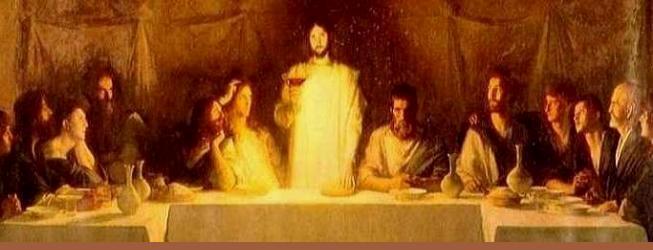


The Last Supper
Christ’s institution of the sacrament of the Eucharist was, and is, the single, greatest gift he left to his Church.  For, it is the fulfillment of his promise to truly be always among us: “And know that I am with you always; yes, to the end of time” (Mt 28:20).  While there are, indeed, multiple and varied presences of Christ, such as: when two or three are gathered in his name; when the People of God gather to celebrate the Liturgy; when Sacred Scripture—the Word—is proclaimed; or when the priest acts in Persona Christi while administering and officiating at any of the Sacraments, etc. The abiding Eucharistic presence of Christ, with the fullness of his Body, Blood, Soul and Divinity is truly singular in its reality, intensity, substance and fullness.
While the accidents of bread and wine remain, the substance is completely transformed into the Second Person of the Trinity. Holy Mother Church refers to this supernatural process—whereby our gifts of bread and wine are wholly transformed into the true presence of Christ—as Transubstantiation.  Thus, while the appearance of bread and wine remain, the substance has been wholly and completely transformed into the very substance of the Second Person of the Holy Trinity. This occurs during the Liturgy of the Eucharist, specifically during the priest’s prayer of consecration, and immediately following the Epiclesis. Regarding the wholly unique presence of Christ, contained within the pre-eminent sacrament of the Holy Eucharist, the Catechism of the Catholic Church has this to say: “The mode of Christ’s presence under the Eucharistic species is unique. It raises the Eucharist above all the sacraments as ‘the perfection of the spiritual life, and the end to which all sacraments tend.’ In the most blessed sacrament of the Eucharist, ‘the body and blood, together with the soul and divinity, of our Lord Jesus Christ and, therefore, the whole Christ, is truly, really, and substantiallycontained.’  This presence is called ‘real’—by which is not intended to exclude the other types of presence, as if they could not be ‘real’ too, but because it is presence in the fullest sense: that is to say, it is a substantial presence by which Christ, God and man, makes himself wholly and entirely present” (CCC §1374).
Lumen Gentium, the Second Vatican Council’s “Dogmatic Constitution on the Church,” refers to the Eucharist as the source from which all the Church’s activity originates, and the summit toward which all the Church’s activity is directed. Based on this essential teaching of the Council, which reiterated 2000 years of Church teaching on the Eucharist, we can come to understand that the Eucharist truly is the “central Sacrament” in the sense that the Eucharist is “the end to which all sacraments tend.” This truth fleshes out the reality that each of the other Sacraments, while possessing a specific purpose in their own right, ultimately serve the greater purpose of leading souls to full participation in the Eucharistic banquet. This is nothing short of a foretaste of the heavenly banquet, where we will participate in God’s own divine life. For example, while the sacrament of Baptism has the specific purpose of forgiving original sin, and imparting sanctifying grace, its greater purpose is to allow the baptized to fully partake of the Eucharistic banquet. For, unless one is Baptized, he or she cannot fully participate in the Liturgy of the Eucharist, and be nourished with Christ’s body and blood. Moreover, it is essential that we be nourished with this “bread from heaven,” because, as Christ himself states: “I tell you most solemnly, if you do not eat the flesh of the Son of Man, and drink his blood, you will not have life in you” (Jn 6:53).  Just as it is with Baptism, so is it with all the remaining sacraments. Reconciliation makes it possible for us to return to the Eucharist after we have fallen. Confirmation imparts the seven-fold gifts of the Spirit to better prepare us to enter into the mystery of the Eucharistic Pasch. Matrimony pre-figures the great wedding-feast of the Lamb, referred to in the book of Revelation, with Christ as the Bridegroom, and his Mystical Body, the Church, as his Bride. Clearly, the sacrament of Holy Orders is primarily concerned with imparting sacramental “character” on the priest’s soul, thereby enabling him to act in Persona Christi, chiefly for the sake of celebrating the Holy Sacrifice of the Mass. This is where, of course, the Eucharist is made present, and with which the Baptized are spiritually nourished. Finally, there is the Anointing of the Sick, of which reception of the Eucharist, or viaticum (bread for the journey), is an integral part. Thus, it is quite clear that each of the Sacraments has, as its ultimate end, the facilitation of participation in the Eucharistic banquet.
As an aside, it most curious that many Protestant groups, especially fundamentalists—who tend to interpret almost all of Scripture in a most literal fashion—stop short of a literal interpretation of Christ’s teachings on the Eucharist, which they strangely regard as merely symbolic.  Let us turn to Scripture itself to read with our own eyes just what Christ stated regarding the Eucharist. Beginning in Jn 6:48, and continuing in John, Jesus states:  “I am the bread of life.  Your fathers ate the manna in the wilderness, and they died. This is the bread which comes down from heaven, that a man may eat of it and not die.  I am the living bread which came down from heaven; if anyone eats of this bread, he will live forever; and the bread which I shall give is my flesh for the life of the world…. Truly, truly, I say to you, unless you eat the flesh of the Son of man, and drink his blood, you have no life in you; he who eats my flesh and drinks my blood has eternal life, and I will raise him up on the last day.  For my flesh is food, indeed, and my blood is drink, indeed.  He who eats my flesh and drinks my blood abides in me, and I in him.” And then again, in Mt 26:26, the following is narrated:  “Now on the night he was betrayed, the Lord Jesus took some bread, and when he had said the blessing, he broke it.  And he gave it to the disciples, saying: ‘Take it and eat.  This is my body.’  Then he took a cup, and when he had given thanks, he gave it to them.  ‘Drink all of you from this,’ he said.  ‘For this is my blood, the blood of the new covenant, which is to be poured out for many for the forgiveness of sins.’”  If fundamentalist Protestant Christians tend to interpret almost everything in Scripture literally, then why not these words of Christ?
Having addressed the above curious issue, let us now discuss the marvelous effects of a well-received Holy Communion. The Catechism of the Catholic Church states that “The principle fruit of receiving the Eucharist in Holy Communion is an intimate union with Christ Jesus.” Moreover, the Catechism continues, Holy Communion “preserves, increases and renews the life of grace received at Baptism” (CCC §1391). Thus, this Living Bread, come down from Heaven, truly nourishes the divine life in our souls.  Just as the body needs material food to be nourished, strengthened and rejuvenated, so, too, does our soul need the spiritual food of the Eucharist to nourish, strengthen, enliven and rejuvenate the divine life that is the soul of our soul.
Secondly, “the Eucharist cannot unite us to Christ without, at the same time, cleansing us from past sins, and preserving us from future sins” (CCC §1393).  Reception of this sacrament increases our charity, and forgives us our venial sins.  Simultaneously, in strengthening our charity, it facilitates our bond with Christ, making it that much more difficult to extinguish the divine life within us, through commission of mortal sin.  Although Holy Communion does, in fact, forgive us our venial sins, we are not permitted to receive this sacrament if we have fallen into mortal sin, as the Eucharist is the sacrament of the living, or those in full communion with the Mystical Body, the Church.  Forgiveness of mortal sins properly takes place within the context of the sacrament of Reconciliation.
What is more, the Eucharist builds up the Church, the Mystical Body of Christ, by uniting us through the bond of charity with Christ, the Head of the Body, and with the members of his Body.  The Eucharist is the fulfillment of the Baptismal grace, which unites and conjoins us to the Church:  “Because there is one bread, we who are many are one body, for we all partake of the one bread” (1 Cor 10:16-17).
The Eucharist is also “A pledge of future glory.” A beautiful ejaculatory prayer, composed by the great St. Thomas Aquinas, and soon adopted by the Church, provides a catechetical summary of the Eucharist. It reads as follows:  “O Sacred Banquet, in which Christ is received, the memory of his passion is renewed, the soul is filled with grace, and a pledge of future glory is given to us.”  It would behoove us to commit this prayerful ejaculation to memory, as it wonderfully, and simply, sums up the most salient catechetical tenets concerning the Eucharistic doctrine.  We are, however, chiefly concerned here with the final thought contained in this prayer.  For, Christ pledges to “raise up on the last day” those who “eat the flesh of the Son of man, and drink his blood.”  The Sacred Liturgy is an earthly foretaste of the heavenly Banquet, the wedding feast of the Lamb, spoken of in the book of Revelation.  Thus, the coming of Christ in the Eucharist takes on an eschatological significance, as each Eucharistic celebration pre-figures the second coming of Christ—that eschatological reality for which the human heart ardently longs, as we pray with the Church:Maranatha! Come, Lord Jesus!
Finally, because Jesus is truly present, in an abiding fashion, with his body, blood, soul and divinity in the Eucharistic species of bread and wine, it is laudable to practice devotion to his Eucharistic presence in the consecrated and reserved host.  A consecrated host should be placed in a monstrance, which should then be placed on the altar, preferably surrounded by candles and flowers, in order that the faithful might practice the pious devotion of Eucharistic Adoration.  While it is theologically correct to say that the Eucharist is primarily meant to be consumed by Catholic Christians in a state of grace, solemn veneration of the Eucharist exposed is a most salutary and pious practice, encouraged by popes, saints and doctors of the Church.  Eucharistic adoration can be seen as a response to Christ’s call to his disciples to “keep watch with [him] for one hour” (Mt 26:40)—hence, the origins of the practice of the Eucharistic Holy Hour.
The Passover:  Christ as the Lamb of Sacrifice and the Pre-figuring of the Paschal Mystery
At the last supper, the single most important Passover meal ever celebrated, Christ manifested his identity as the Passover lamb of sacrifice.  In the Old Testament, during the very first Passover, the Israelites prepared a sacrificial meal in haste, as they prepared to be set free from their slavery in Egypt. On this occasion, an innocent, unblemished lamb was sacrificed.  The blood of the sacrificed lamb was placed on the doorposts of the Israelites houses, to save the firstborn males from death.  The lamb, which was slain as a sacrifice to the Father, was then consumed by the Israelites to strengthen them for their journey through the desert, toward the Promised Land. Moreover, as the Jews wandered throughout the desert, they were fed with manna, a bread from heaven, which was divinely given to them by God on a daily basis.  In the New Testament, Jesus is the unblemished Lamb of God, who offers himself as a sacrifice of atonement to the Father, thereby saving us from the death of sin and hell, setting us free from our slavery to sin.  It is precisely his blood that saves us from spiritual death.  Moreover, Jesus offers us his own body, which has just been sacrificed, to spiritually strengthen us on our journey through the desert of this life, as we make our way to the Promised Land of Heaven.  Moreover, Jesus is the manna, the “bread from heaven,” that we are nourished with, on a day-to-day basis, according to the providence of the Father, and his unfailing solicitude for the spiritual, and material, well-being of each of his children.
Thus, to truly enter into the mystery of the Eucharistic Pasch, we need to turn our attention to the Old Testament narrative of the very first Passover meal.  Only then, will we begin to understand, however superficially (after all, this is a mystery of the deposit of faith):  the tremendous significance of our Eucharistic Passover meal—the sacrifice in the Holy Sacrifice of the Mass; and the grand mystery of Christ’s infinite, perfect, merciful and, sadly, often unrequited, love for humanity—in his real presence in the Eucharist.
About Jayson M. Brunelle, M.Ed., C.A.G.S
Jayson M. Brunelle, M.Ed., C.A.G.S., holds a B.A. in philosophy and theology from Franciscan University of Steubenville, Ohio; an M.A. in education in counseling psychology, a certificate of advanced graduate studies in clinical mental health counseling from Springfield College, Springfield, Massachusetts; and a certificate of completion from the pre-theology program at St. John’s Seminary, Brighton, Massachusetts. Brunelle has been published in the Homiletic and Pastoral Review and Lay Witness, and presented papers at the 8th International Congress on Constructivism and Psychotherapy in Bari, Italy. He is the author of the books: The Blessed Mother’s Plan to Save Humanity, Consecration to Jesus Christ through Mary and Joseph, and The Five Ways of Aquinas. He has guest-lectured at Springfield College, Western New England College, and Holyoke Community College, and worked as a chaplain at Suffolk County Prison.

Jun 8, 2012

Et Incarnatus Est

I think it's about time I explain why the blog has its title.  It comes from the Latin original of the Credo (the one where we say "incarnate of the Virgin Mary", thanks to the new translation that debuted during Advent), which literally is, "et incarnatus est".  He was incarnate of the Virgin Mary.

The incarnation of Christ is extremely unique, very powerful, and astonishing.  What do you mean, he took on our skin and bones (that's what incarnate means) and dwelt among us?  This is at the heart of everything Christians believe.  We believe that God became man. This has extraordinary impact on all our lives, especially given our doctrine of baptism, where we outwardly look like we're just getting sprinkled with some water, but we are actually being initiated into the family of God.  That's pretty intense, no?  Literally, that's our adoption ceremony - we are literally cleansed and receive the Holy Spirit. We become heirs to God!!  This also means we take part in the life and love of the Trinity.

What else does this mean, though?  We are sons of God through this adoption, which is pretty incredible.  That means we are Christ to the world.  The incarnation of Christ happens again and again throughout history, especially through his followers.  What we do has a huge impact because of this!  We are ambassadors of Christ - what we do as Christians, the world follows as though we were Christ ourselves. We must be very careful to live as good examples.

There are other implications to the incarnation of Christ, though.  We are a people of Christmas and Easter.  Christ took on flesh, and sacrificed it.  That's why He did it.  He did it to pour Himself out for all of us.  We believe in this bodily reality of Christ, which is the source, summit, and summary of all our Christian lives.  Even marginal Christians understand that if you go to Church at all, you do it on Christmas and Easter, where we celebrate the body and corporal reality of Christ. The bodily reality of Christ is the singular most important belief we hold not only as Christians, but Catholics.  All the sacraments are about embodying Christ, giving Christ a body, being a tabernacle, being a physical, present symbol for the realities of God.  We are asked to be like Mary and carry Him about and bring Him forth as a gift in the world. We don't have control over what the world does with the incarnation of Christ; we are asked to bring Him forth anyway.

Now, in light of the coming feast of Corpus Christi (the body of Christ), we should remember that the bodily presence of Christ permeates all parts of our lives as Christians (because it is easy to forget - why do you think God tells the Israelites so many times to "remember"?).  We have the Eucharist!  I posted the homily Pope Benedict gave - the Eucharist is the ultimate proof that Christ has never abandoned us.  He is always physically present in the Eucharist.  St. Peter Emyard said that Christ takes on the form of a dead corpse in the bread, but His Heart is ever blazing with love and fully alive. He trusts us to take Him into the world and live out the incarnation every day.

Christians, in sum, have reason to celebrate.  Christ dwelt among us, as a incredibly present, corporeal person, and still dwells with us today!

EWTN.com - That Bread Is Really Jesus Christ

EWTN.com - That Bread Is Really Jesus Christ

7-June-2012 -- ZENIT.org News Agency


That Bread Is Really Jesus Christ

Rome's Director of Liturgy Explains Importance and Meaning of Corpus Christi Feast

By Salvatore Cernuzio

ROME, JUNE 5, 2012 (Zenit.org).- This Thursday, Benedict XVI will preside over Holy Mass in the courtyard of Saint John Lateran, and then lead the procession of the Body of Christ to the Basilica of Saint Mary Major.

To prepare for this feast of Corpus Christi, ZENIT interviewed Carmelite Father Giuseppe Midili, director of the Liturgical Office of the Vicariate of Rome.

ZENIT: Corpus Christi celebrates the Eucharist, fulcrum of the Christian faith. What is the meaning of this solemnity?

Father Midili: Eucharist means thanksgiving. Every day, especially on Sunday, the Church gathers to celebrate the holy mysteries and to thank the Father for the gift of his Son, who offered his life in sacrifice for us and merited salvation for us. The Solemnity of the Body and Blood of the Lord is the liturgical occasion for a special thanksgiving. The Christian community gathers to become conscious that only in the Eucharist does it find the summit and source of its whole life. Every act of faith, every form of piety, of devotion, every form of genuine charity can never do without this sacrament.

ZENIT: The birth of this feast goes back to what date?

Father Midili: The Solemnity of the Body and Blood of the Lord was instituted in 1264 by Pope Urban IV, so that the Christian people could participate with special devotion in the Holy Mass and in the procession, and thus witness their faith in Jesus, who willed to remain present under the species of consecrated bread and wine. In the course of the centuries this solemnity constituted the highest point of Eucharistic devotion, because it united devoted adoration to that original event, which we cannot do without, which is the celebration of the Mass.

ZENIT: The celebration of Corpus Christi at Saint John Lateran was started by John Paul II. Why did he wish to give it such great importance?

Father Midili: Since the year 1979 Pope John Paul II wanted the Solemnity of the Body and Blood of the Lord to be celebrated in Rome on Thursday, because in fact on Holy Thursday Jesus gathered his disciples and during the Supper instituted the new and eternal sacrifice, the nuptial banquet of love. On the feast of Corpus Christi this same mystery is proposed for the adoration and meditation of the People of God.

The Pope wished to celebrate in the Cathedral of Rome, together with all the priests and faithful of the city, because the Eucharist is the mystery of communion with God, but also among persons. The best image of the Church, in fact, is that which is constituted around the Bishop to celebrate the divine mysteries, to eat and drink the Body and Blood of the Lord, to give thanks and thus witness the communion and love that Jesus taught.

ZENIT: Why is this feast in the courtyard of the Basilica of Saint John?

Father Midili: Saint John's Square is at the same time the courtyard of the Basilica Cathedral of Rome, but it is also the place of public gatherings for the city and for Italy; it is often the scene of concerts, of political events and, unfortunately, also of clashes; it is the Agora of the ancients. It became a symbol of our country, it is a courtyard-square.

To celebrate Holy Mass in such a significant place on the day of the feast of the Eucharist confirms that Jesus is in the midst of his people at every moment of life. He sanctifies the everyday with his presence, sees and heals suffering, he is for all a sign of hope. Jesus is not far from us and from our life, but is always present, he made himself close. We can meet him in the celebrated Eucharist and in the consecrated bread. He comes to meet us.

ZENIT: The procession, led by the Holy Father is an event of great impact whose central idea is that "Christ walks in our midst."

Father Midili: The Holy Mass and procession on the Solemnity of the Body and Blood of the Lord is a unique event, which manifests the Church as Church. It is the feast of the gathered community. Believers come together to celebrate the sacrifice of Christ and, in the celebration, they thank God for all that they have received. The best image of the Church is the one gathered around her bishop to celebrate the holy mysteries, to eat and drink the Body and Blood of the Lord, to give thanks and thus witness the communion and love that Jesus has taught us.

Adoration is the continuation of the celebrated Eucharist, testimony of love and faith toward Jesus, prolongation of the thanksgiving after every Holy Communion. Once again the Church identifies herself with the journeying people, who follow their Master. The experience of the disciples of Emmaus is repeated, who travel a way with Jesus and listen to him while he instructs them. In the Eucharistic procession the community journeys with Jesus, but does not recognize him more while he breaks the bread. We recognize the Master present in that bread.

[Translation by ZENIT]

EWTN.com - Pope's Corpus Christi Homily

EWTN.com - Pope's Corpus Christi Homily


8-June-2012 -- ZENIT.org News Agency


Pope's Corpus Christi Homily


ROME, JUNE 7, 2012 (Zenit.org).- This evening in Rome, Benedict XVI celebrated Mass for the feast of Corpus Christi at the Basilica of St. John Lateran. He then led the traditional procession to the Basilica of Saint Mary Major.

Here is a translation of the Pope's homily.

* * *

Dear Brothers and Sisters!

This evening I would like to meditate with you on two interconnected aspects of the Eucharistic Mystery: the worship of the Eucharist and its sacredness. It is important to take it up again to preserve it from incomplete visions of the Mystery itself, such as those which were proposed in the recent past.

First of all, a reflection on the value of Eucharistic worship, in particular adoration of the Most Blessed Sacrament. It is the experience that we will also live after the Mass, before the procession, during its development and at its end. A unilateral interpretation of Vatican Council II has penalized this dimension, restricting the Eucharist in practice to the celebratory moment. In fact, it was very important to recognize the centrality of the celebration, in which the Lord convokes his people, gathers them around the twofold table of the Word and the Bread of life, nourishes them and unites them to Himself in the offering of the Sacrifice. This assessment of the liturgical assembly, in which the Lord works and realizes his mystery of communion, remains of course valid, but it must be placed in the right balance. In fact - as often happens - the stressing of one aspect ends up by sacrificing another. In this case, the accentuation placed on the celebration of the Eucharist has been to the detriment of adoration, as act of faith and prayer addressed to the Lord Jesus, really present in the Sacrament of the altar. This imbalance has also had repercussions on the spiritual life of the faithful. In fact, concentrating the whole relationship with the Eucharistic Jesus only at the moment of Holy Mass risks removing his presence from the rest of time and the existential space. And thus, perceived less is the sense of the constant presence of Jesus in our midst and with us, a concrete, close presence among our homes, as "beating Heart" of the city, of the country, of the territory with its various expressions and activities. The Sacrament of the Charity of Christ must permeate the whole of daily life.

In reality, it is a mistake to oppose celebration and adoration, as if they were in competition with one another. It is precisely the contrary: the worship of the Most Blessed Sacrament is as the spiritual "environment" in which the community can celebrate the Eucharist well and in truth. Only if it is preceded, accompanied and followed by this interior attitude of faith and adoration, can the liturgical action express its full meaning and value. The encounter with Jesus in the Holy Mass is truly and fully acted when the community is able to recognize that, in the Sacrament, He dwells in his house, waits for us, invites us to his table, then, after the assembly is dismissed, stays with us, with his discreet and silent presence, and accompanies us with his intercession, continuing to gather our spiritual sacrifices and offering them to the Father.

In this connection, I am pleased to stress the experience we will also live together this evening. At the moment of adoration, we are all on the same plane, kneeling before the Sacrament of Love. The common and ministerial priesthoods are united in Eucharistic worship. It is a very beautiful and significant experience, which we have experienced several times in Saint Peter's Basilica, and also in the unforgettable vigils with young people - I recall, for example, those of Cologne, London, Zagreb, Madrid. It is evident to all that these moments of Eucharistic vigil prepare the celebration of the Holy Mass, prepare hearts for the encounter, so that it is more fruitful. To be all together in prolonged silence before the Lord present in his Sacrament, is one of the most genuine experiences of our being Church, which is accompanied in a complementary way with the celebration of the Eucharist, listening to the Word of God, singing, approaching together the table of the Bread of life. Communion and contemplation cannot be separated, they go together. To really communicate with another person I must know him, I must be able to be in silence close to him, to hear him and to look at him with love. True love and true friendship always live of the reciprocity of looks, of intense, eloquent silences full of respect and veneration, so that the encounter is lived profoundly, in a personal not a superficial way. And, unfortunately, if this dimension is lacking, even sacramental communion itself can become, on our part, a superficial gesture. Instead, in true communion, prepared by the colloquy of prayer and of life, we can say to the Lord words of confidence as those that resounded a short while ago in the Responsorial Psalm: "O Lord, I am thy servant; I am thy servant, the son of thy handmaid. / Thou hast loosed my bonds./ I will offer to thee the sacrifice of thanksgiving /and call on the name of the Lord" (Psalm 115:16-17).

Now I would like to pass briefly to the second aspect: the sacredness of the Eucharist. Also here we heard in the recent past of a certain misunderstanding of the authentic message of Sacred Scripture. The Christian novelty in regard to worship was influenced by a certain secularist mentality of the 60s and 70s of the past century. It is true, and it remains always valid, that the center of worship is now no longer in the rites and ancient sacrifices, but in Christ himself, in his person, in his life, in his paschal mystery. And yet, from this fundamental novelty it must not be concluded that the sacred no longer exists, but that it has found its fulfillment in Jesus Christ, incarnate divine Love. The Letter to the Hebrews, which we heard this evening in the Second Reading, speaks to us precisely of the novelty of the priesthood of Christ, "high priest of the good things that have come" (Hebrews 9:11), but it does not say that the priesthood is finished. Christ "is the mediator of a new covenant" (Hebrews 9:15), established in his blood, which purifies our "conscience from dead works" (Hebrews 9:14). He did not abolish the sacred, but brought it to fulfillment, inaugurating a new worship, which is, yes, fully spiritual but which however, so long as we are journeying in time, makes use again of signs and rites, of which there will be no need only at the end, in the heavenly Jerusalem, where there will no longer be a temple (cf. Revelation 21:22). Thanks to Christ, the sacred is more true, more intense and, as happens with the Commandments, also more exacting! Ritual observance is not enough, but what is required is the purification of the heart and the involvement of life.

I am also pleased to stress that the sacred has an educational function, and its disappearance inevitably impoverishes the culture, in particular, the formation of the new generations. If, for example, in the name of a secularized faith, no longer in need of sacred signs, this citizens' processions of the Corpus Domini were abolished, the spiritual profile of Rome would be "leveled," and our personal and community conscience would be weakened. Or let us think of a mother or a father that, in the name of a de-sacralized faith, deprived their children of all religious rituals: in reality they would end up by leaving a free field to so many surrogates present in the consumer society, to other rites and other signs, which could more easily become idols. God, our Father, has not acted thus with humanity: he has sent his Son into the world not to abolish, but to give fulfillment also to the sacred. At the height of this mission, in the Last Supper, Jesus instituted the Sacrament of his Body and his Blood, the Memorial of his Paschal Sacrifice. By so doing, he put himself in the place of the ancient sacrifices, but he did so within a rite, which he commanded the Apostles to perpetuate, as the supreme sign of the true sacred, which is Himself. With this faith, dear brothers and sisters, we celebrate today and every day the Eucharistic Mystery and we adore it as the center of our life and heart of the world. Amen.

[Translation by ZENIT]

Mar 7, 2012

Let's talk about the centurion

I hadn't prepared to post anything but today felt like a necessary post so pardon the scantness of depth. Luke 7 opens with the healing of the Centurion's servant. This is a passage I remember hearing every once in a while in church but its meaning became much more immediate to me when I learned that we used it in mass! (Shout out to Scott Hann and Supper of the Lamb!) Now, of course we use it more directly in the new translation but anyway, I flipped open the Bible and this passage came up.
What I find really interesting is that Jesus said this man, a Roman, not an Israelite, has more faith than anyone he has seen in all his ministry. And what is Jesus reacting to give such an astounding proclamation? After humbly stating he is not worthy of Jesus entering his house, the centurion says: "I, too, am a man placed under the authority of superior officers, and I have soldiers under me." (Luke 7:8) This man is acknowledging what Jesus says throughout the gospel, that He is there to do the will of the One who sent Him, God the Father. But, in the same way that Jesus subjects Himself to His Father's will, those who follow Christ must do as He commands. The Centurion is not an extraordinary man except in one feature: his great love.
The Centurion is coming to Christ on behalf of his dear servant, a man he loves deeply as a friend and fellow soldier. We know that he loves and is charitable also by the elders begging of Jesus, "This man really deserves your help. he loves our people and he himself built a synagogue for us." (Luke 7:4-5) How different is the Centurion from these elders though! He loves greatly but does not boast of his deserving! He does not say, "Heal my servant for I have given your people a temple!" No, rather he says, "Sir, don't trouble yourself. I do not deserve to have you come into my house, neither do I consider myself worthy to come to you in person. Just give the order, and my servant will get healed." (Luke 7: 6-7 *As you can tell, this is an odd translation but it's what I have on hand right now). This speaks to the wisdom of the Centurion in understanding Authority.
Just as the Centurion reports to and does the will of his commander, so must Jesus do the will of His Father. And what is the will, the order, the word, of our Father? It is Jesus. That is His command, that is His cry of salvation for us, that is the Word that will heal us. When the Centurion tells Jesus "only say the word and my servant shall be healed" he acknowledges Christ as his superior and also as the Word of God. While He was on earth, Christ put Himself under His Father's will but in truth, this does not make Him less God than our Father is. The Father always has authority over the Son, much as it is in any human relationship. But, in the incomprapble Blessed Trinity, Jesus is in fact one with the Father and the Holy Spirit. His personhood in God is to be subjected to the Father's will while at same time His entire being is the Father's will. The Word that heals the servant is Jesus.
I apologize for rambling. God, please grant us the humility and wisdom of the Centurion in that we may recognize Jesus as our saving grace and Your true Son. May we seek him humbly and confess our weakness to Him so that He may say the Word, Your Word, and heal us that we may be reunited to you. Amen.

Jan 26, 2012

Importance of Spiritual Friendships

It has been a LONG time since I've posted on this blog but on a lonely night it is good to come back. Today is the feast day of Saints Timothy and Titus. The readings and reflections in the Magnificat emphasize that they were friends and helpers of St. Paul who had very different spiritual gifts. Timothy is called Paul's confidant whereas Titus is the negotioater, a peacemaker as the Beatitudes would list him. Both men helped Paul and the early Church spread the Gospel and they helped each other also grow in faith through their friendships which were solidly founded on their common faith.

Friends are those who inspire us to be better than we currently are and do God's work in pushing us to be more like Christ. A friend fueled by the love of God will encourage you to "be perfect as your Heavenly Father is perfect" not only in words but in their own actions. At the end of the day, without support and friendship, I feel we all will fall short and become hypocrites in our faith, saying one thing while doing another. It is very hard to live a good Christian life when you are not surrounded by good Christians who will admonish you for your wrongdoings and praise God with you for His many gifts and virtues He's bestowed upon you. As of late, I have been wholly lacking in spiritual friendships and I certainly feel that missing in my heart.

St. Paul tells us, as he told Titus in his letter, "For a bishop must be without crime, as the steward of God: not proud, not subject to anger, nor given to wine, no striker, not greedy of filthy lucre: 8 But given to hospitality, gentle, sober, just, holy, continent: 9 Embracing that faithful word which is according to doctrine, that he may be able to exhort in sound doctrine and to convince the gainsayers." Though we are not all bishops, this advice applies the same to all of us. How different might we act every day if we had a friend remind us of these things? If we had someone who cared enough about our relationship to God to call and check on us spiritually? Spiritual brothers and sisters, be sure to pray for one another and check on one another. None of us can get through this alone. The journey of this life requires us to have companions, "It is not good for man to be alone". Spiritual relationships, whether they be romantic or friendships, are a necessary and joy filled obligation to come closer to our Lord. Let's embrace such friendships and keep Christ at the center of all things in our lives.
God bless!